
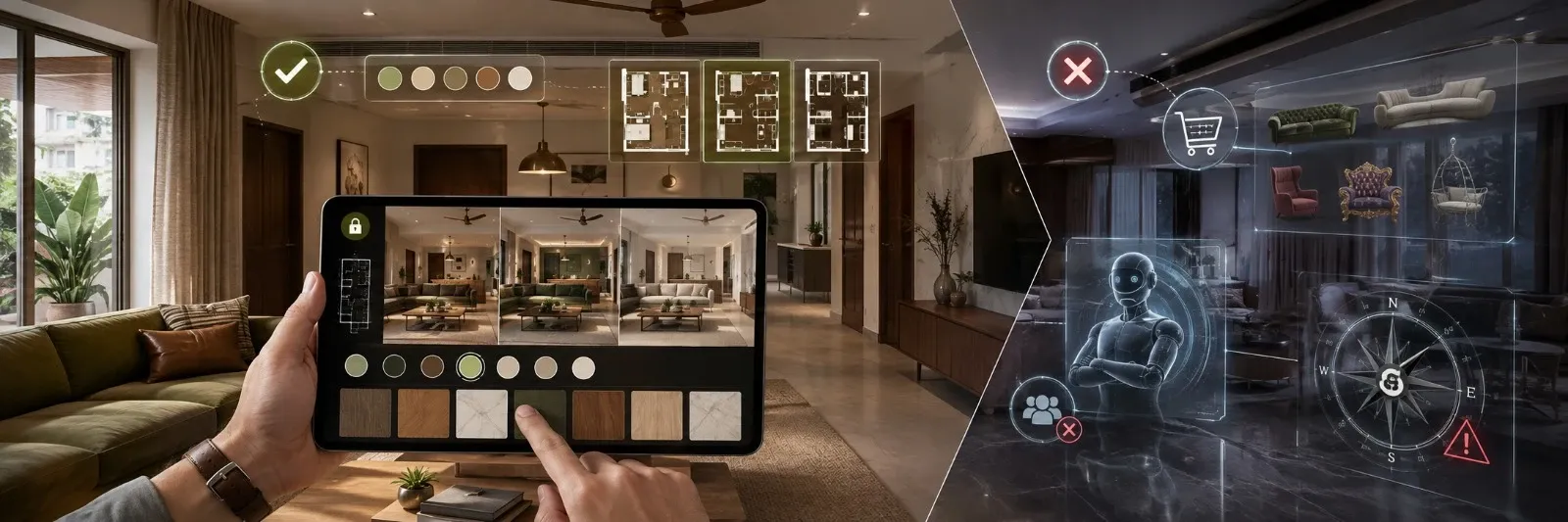
AI Interior Design Trends 2026: What's Actually Useful vs. What's Just Hype
Every trend roundup this year opens with the same line. AI is "revolutionizing" interior design, transforming how homes get planned, blah blah. Some of it's true, genuinely. Most of it is marketing copy wearing a trend piece's clothes.
Worth sorting the two apart. Here's what's real, what's exaggerated, and what's flat out not happening yet, at least not for anyone in India reading this.
Actually Useful: Renders That Keep Your Actual Room Intact
Two years ago, upload a photo and you'd get back something vaguely resembling your room, walls in slightly wrong places, a window that used to be there just gone. That's mostly fixed now. Structural lock, whatever a given tool calls it, keeps your real walls, windows, and doors in place while restyling everything else. This is the single biggest jump in the category, and it's not hype, it's the difference between a tool being genuinely useful and being a novelty.
Actually Useful: Testing Five Directions Costs Nothing
An hour with a designer used to mean picking one mood board and hoping. Now you can generate a warm minimalist version, a moody dark one, something traditional, all from the same photo, all in the time it takes to make tea. That speed is real, it's measurable, and it changes how people actually approach the early planning stage.
Actually Useful: Seeing a Colour or Material Before You Buy It
This might be the single most valuable thing AI design tools do, full stop. That olive cabinet or navy wall that looked perfect on someone's Instagram post can look completely different once it's rendered under your own room's light. Testing it first, before a litre of paint gets bought, catches one of the most common and expensive regrets in any renovation.
Hype: "AI Is Replacing Interior Designers"
Read enough of these AI company blogs and you'll notice something funny, even they don't actually claim this in their own FAQ sections. Buried under the marketing headline is usually a line admitting AI is an accelerant, not a substitute, that structural work, code compliance, and actual client judgement still need a human. If the companies selling the tools won't claim full replacement, that tells you something about how seriously to take anyone else who does.
Hype: Click-to-Cart Shopping From Your Render
Some US platforms genuinely do this well now, generate a design, click the sofa, it arrives at your door. Real feature, works as advertised, over there. For Indian homeowners specifically, this mostly doesn't exist yet. Retailer integrations are heavily skewed toward US catalogs, IKEA, Wayfair, West Elm, and matching an AI-suggested piece to something actually available from an Indian vendor still means manual searching. Not a coming-soon feature quietly rolling out. A genuine regional gap, worth knowing about before you expect it.
Hype: AI That "Understands" Vastu or Local Context
Marketing copy occasionally implies AI tools grasp cultural or regional design considerations out of the box. They don't, not really. Mainstream tools are trained overwhelmingly on global datasets, and vastu placement, kitchen direction, bed orientation, mandir positioning, has to be explicitly typed into every prompt, every time, or it simply gets ignored. That's not a criticism of the technology exactly, it's just a gap between what gets implied and what's actually happening under the hood.
Genuinely Mixed: Free Tiers and What You're Actually Allowed to Do With Them
Here's a catch that doesn't get mentioned enough. A lot of free-tier and even entry-level paid renders come with usage restrictions that quietly exclude commercial use. Generate a design on a free plan, then use it in a paid client deliverable or a property listing, and you may technically be violating that tool's terms without realising it. Worth checking the licence tier before publishing anything, not after.
Where the Aesthetic Trends and the Tech Actually Line Up
Interesting thing happening in 2026 specifically. Warm minimalism, textured natural materials, chocolate and earthy browns replacing the cool grey era, these are the aesthetic trends designers keep citing as genuinely dominant this year. And AI rendering tools have gotten meaningfully better at rendering exactly this kind of warmth, wood grain, plaster texture, layered lighting, convincingly. The aesthetic direction people actually want and the thing AI is now good at rendering happen to be the same thing this year, which is either a coincidence or evidence that AI tools trained on recent interior photography are simply reflecting what's already trending.
Quick Reference: Useful vs. Hype at a Glance
|
Claim |
Verdict |
Why |
|
Renders preserve your actual room's structure |
Useful |
Genuine technical improvement over 2024-era tools |
|
Testing multiple styles in minutes |
Useful |
Real, measurable time savings over traditional consultation |
|
Material and colour testing before buying |
Useful |
Catches expensive regret before it happens |
|
AI replaces interior designers |
Hype |
Even AI companies' own FAQs contradict this |
|
Shoppable AI-to-cart in India |
Hype (for now) |
Retailer integration is US-centric, manual search still needed here |
|
AI understands vastu automatically |
Hype |
Zero built-in awareness, must be stated explicitly every time |
|
Free tier is fine for commercial use |
Mixed |
Often restricted, check licensing before publishing |
Overall Conclusion
Strip away the marketing language and 2026's genuine AI advances are fairly specific: better structural consistency in renders, faster iteration, and a real ability to preview materials before spending money. Everything else, full designer replacement, seamless AI shopping in every market, built-in cultural awareness, is either overstated or simply not built out yet for Indian homeowners specifically. Knowing which is which saves you from expecting a tool to do something it was never actually capable of.
In Case You Missed Anything
Everything you need to know about transforming your space with AI
Genuinely more accurate than a couple of years back, especially at preserving a room's real structure while restyling it. Where the hype creeps in is claims about full replacement of human judgement, that part's overstated.
No, and this isn't even contested much anymore. Structural feasibility, vendor coordination, and genuine client judgement calls still need a person. AI speeds up the early visualisation stage, nothing more.
Not really, not yet. That feature works reasonably well on some US platforms tied to US retailers. For Indian vendors, matching a render's suggested piece to something you can actually buy still means manual searching in most cases.
Not automatically, no. If vastu placement matters to your home, it needs to be spelled out directly in the prompt every time, since mainstream tools have no built-in awareness of it whatsoever.
Testing colours and materials against your own room's actual lighting before committing money to them. This alone prevents one of the most common and expensive regrets in any renovation project.
Usable for genuine exploration and personal projects, yes. The catch is commercial use, a lot of free tiers restrict this, so check the licensing terms before using a free-tier render in any paid or published context.
Any claim that AI alone can take a project from concept to finished construction without a professional involved. That framing shows up in marketing more than it shows up in reality.